IntroductionIn
clinical practice, waiting for a drop in blood pressure to suspect shock is often too late.Hypotension is a late sign of compensatory failure. To save lives, nurses must develop a “clinicaleye” for the early, subtle physiological shifts of occult shock.
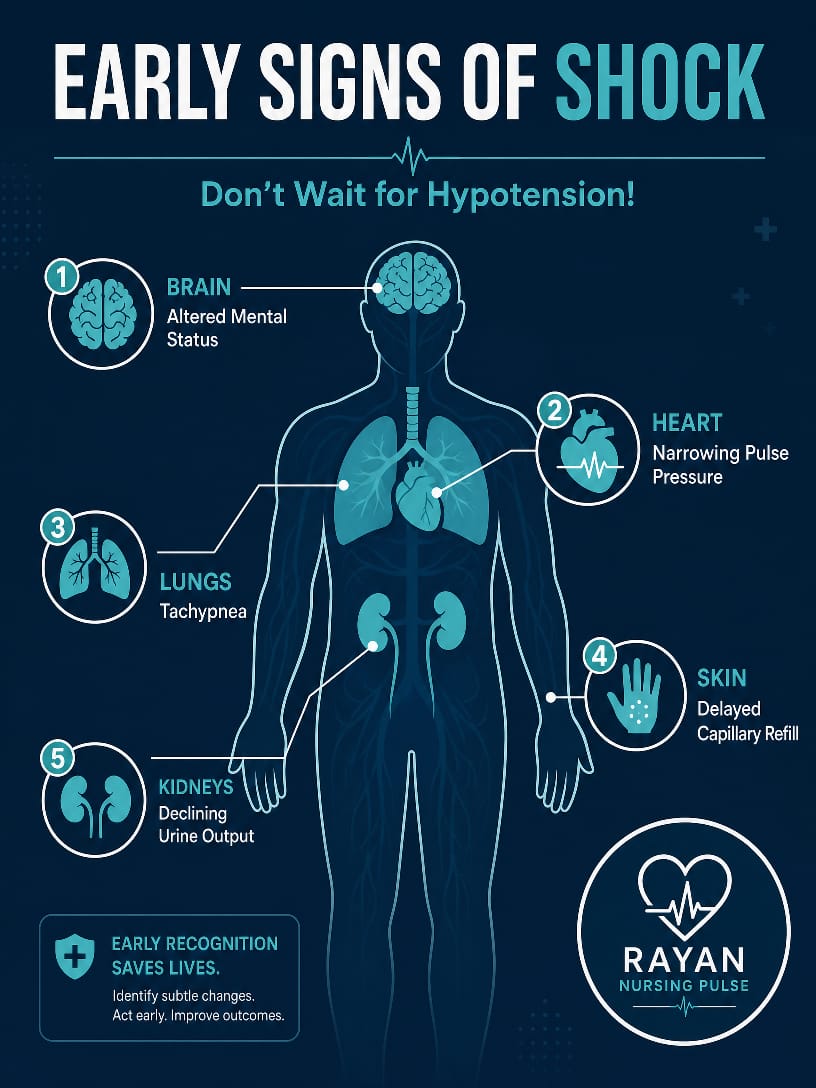
The 5 Critical Indicators
1. Altered Mental Status (The Brain’s First Cry) Even slight agitation, confusion, orrestlessness can indicate decreased cerebral perfusion. Before checking the monitor, checkthe patient’s level of consciousness (GCS).
2. Narrowing Pulse Pressure While the systolic might look “normal,” a rising diastolicpressure (due to vasoconstriction) leads to a narrow pulse pressure (less than 25% of thesystolic). This is a classic early sign of compensatory shock.
3. Delayed Capillary Refill & Skin Changes Peripheral vasoconstriction shunts blood to vitalorgans. Look for a capillary refill time > 3 seconds, or skin that feels cool, clammy, orappears mottled (livedo reticularis), especially in the extremities.
4. Unexplained Tachypnea (The Respiratory Compensation) An increase in respiratory rateis often the earliest sign of metabolic acidosis (lactic acid buildup). If your patient isbreathing 22+ times per minute without a clear respiratory cause, suspect shock.
5. Declining Urine Output (The Renal Indicator) The kidneys are highly sensitive toperfusion changes. A drop in urine output (< 0.5 mL/kg/hr) indicates that the body isconserving fluid and that renal perfusion is compromised.